


Note: on days like today, formatting = "NADA" content = "KING" - Yoda
VIX Index Rises 73% As New Volume Records Are Set – By Matt Moran
Posted: 15 Oct 2014 06:58 PM PDT
Oct. 15, 2014 — The S&P 500® (SPX) Index declined by 5.4% and the VXST Index rose 113.3%. over the past week, and many investors are looking for havens to help protect their portfolios from left tail risk.
RECORD VOLUME TODAY
Since early this month, there have been dramatic increases in trading volume in tools that can be used to manage portfolio risk, including the SPX options, and futures and options on the CBOE Volatility Index® (VIX®).

Today a CBOE Holdings press release noted the following records –
S&P 500 Index (SPX) Options at CBOE
Trading of options on the S&P 500 Index (SPX) at CBOE set a new single-day volume record on Wednesday, October 15, as 2,671,462 contracts (estimated) traded, surpassing the previous high of 2,282,029 contracts on June 20, 2013.
VIX Index Futures at CFE
At CBOE Futures Exchange (CFE), trading of futures on the CBOE Volatility Index (VIX) set consecutive single-day volume records on Tuesday, October 14 and Wednesday, October 15, with 616,906 contracts and 791,638 contracts (estimated) traded, respectively. These records surpassed the previous high of 528,628 VIX futures contracts on August 1, 2014.
Total Volume Record at C2
C2 Options Exchange (C2) set a new single-day exchange-wide volume record on Wednesday, October 15, as 714,529 options contracts (estimated) traded, eclipsing the previous high of 665,789 contracts on February 3, 2014. … “
% CHANGES TO INDEXES FROM OCT. 8 TO OCT 15
As shown in the table below, over the past week the VIX Index rose 73.7%
and the VXST Index rose 113.3%.

§ -5.4% 1862.49 SPX – S&P 500
§ 14.5% 20.04 GVZ – CBOE Gold Volatility Index
§ 43.8% 36.36 OVX – CBOE Crude Oil Volatility Index
§ 44.8% 129.01 VVIX – CBOE VIX of VIX Index
§ 55.3% 7.72 VXTYN – CBOE/CBOT 10-year Treasury Note Volatility Index
§ 56.8% 26.48 VXEFA – CBOE EFA ETF Volatility Index
§ 73.7% 26.25 VIX® – CBOE Volatility Index®
§ 113.3% 31.12 VXST – CBOE Short-Term Volatility Index


r more information on 26 volatility indexes and tools for risk management in volatile markets, please visit www.cboe.com/volatility.
The VIX is at a crossroads – mind the gap.
Posted: 15 Oct 2014 09:27 AM PDT
As you, dear patient reader, have no doubt noticed, volatility is back. The VIX® has reached levels not seen since the peak of the Eurozone crisis over two years ago. The exact reasons might be debatable, but either way October is living up to its perennial reputation as the cruelest month for equities.
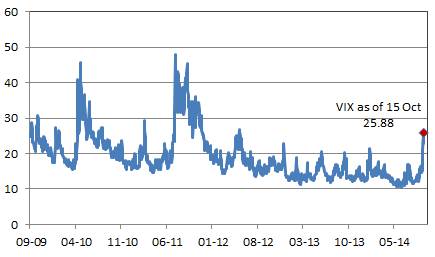
Source: CBOE
Each time in recent history that the VIX closed above 20, it has rapidly collapsed (see above). And duly following the principle of induction, spikes in volatility are now interpreted as a selling opportunity (in respect of the VIX) by the average punter. One example of this demand: the largest exchange-traded product providing a short exposure to VIX futures has doubled in shares outstanding in the last few days:
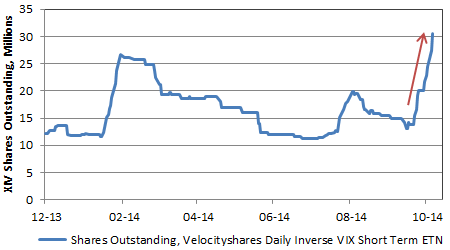
Source: Bloomberg, as of Oct 15th
Yet volatility levels are not guaranteed to fall. If the U.S. Federal Reserve’s largess was indeed the primary cause of the suppressed levels of volatility seen in the first three quarters of this year, the seat-belts are off. QE3 is expected to end in the next few weeks; history was not kind to equity investors in the periods immediately following the last two rounds:
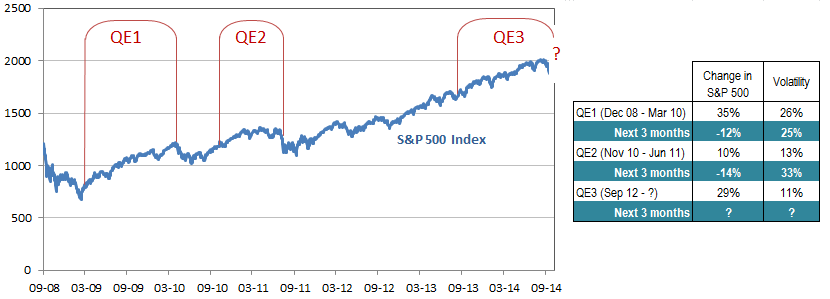
Source: S&P Dow Jones Indices
It requires an unusual degree of foresight, bravery or foolishness to take short positions in the VIX; there are, notoriously, considerable stings in the tail. Moreover, it is a bet framed in terms of death or glory: the VIX rarely resides in the low 20s, instead historically it is brief staging post on the way to crisis or back to recovery. And despite the enthusiasm for selling volatility at current levels, losses can escalate very quickly if it continues to spike. At some point, those short investors will capitulate; the risk is then a material short squeeze.
Hypothetically, such a short squeeze would trigger large purchases in volatility futures just as it is already shooting up. A jump from 25 to 35 in such circumstances is not entirely unfeasible. Investors would be wise to mind the gap.


